
Last week, the Indian Ocean Tuna Commission met in Malé, Maldives, for its 30th Session. A broad range of topics were discussed through 17 proposals, including data reporting, the Biodiversity Beyond National Jurisdiction Agreement (BBNJ), transhipment, and live release and handling of mobulid rays. Perhaps the most important and challenging discussions, though, centred around a new management measure for Indian Ocean yellowfin tuna.
Yellowfin tuna management was a key area of focus for IPNLF this year. We called for the adoption of a measure which included a binding total allowable catch (TAC) based on scientific advice with an equitable catch limit for all countries. On the final day, the Commission agreed on a TAC of 436,867t, due to be in place for 2027 and 2028, with quotas divided among members. However, assessing this new measure is a complex task.
When assessing the stock, the Scientific Committee recommended a TAC of 421,000t, within a maximum sustainable yield (MSY) range of 416,000 – 430,000t. This advice came after years of catches exceeding scientific advice and a recent stock status improvement from red to green in 2024, though uncertainties in the data were expressed at the time. The adopted TAC of 436,867t exceeds both the advice and the range of MSY and this raises obvious concerns.
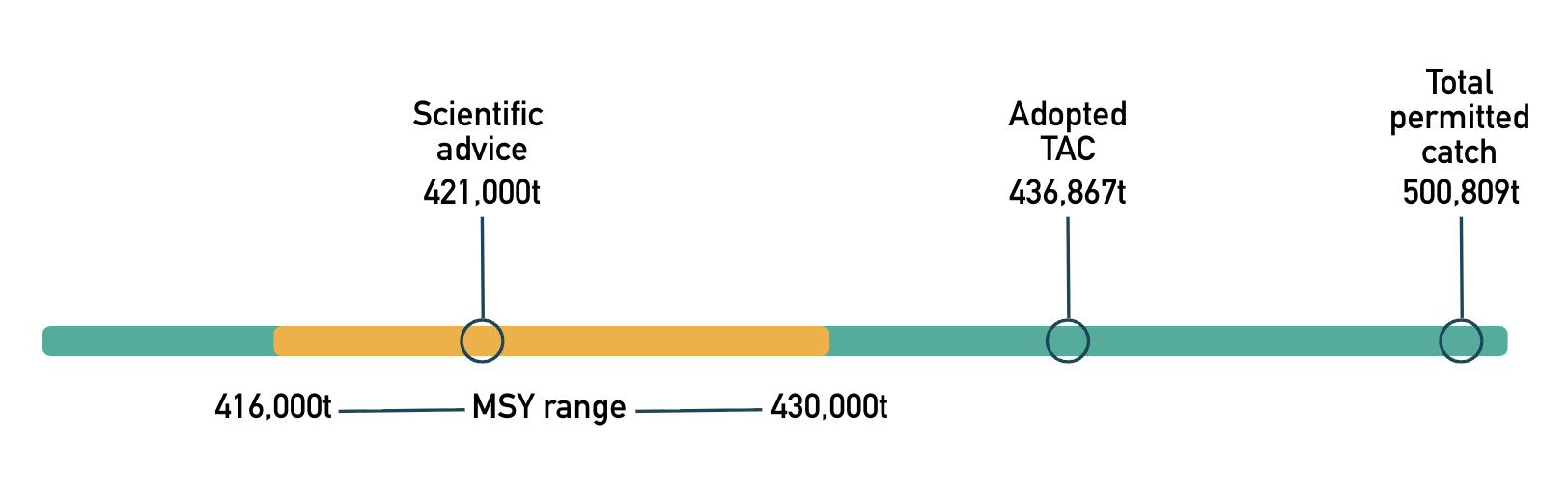
Illustration of the figures associated with the development of the total allowable catch for Indian Ocean yellowfin tuna.
When assessing the adoption of this new measure, it is also important to recall that the situation for yellowfin tuna management coming into this year’s IOTC meeting was highly problematic. Since the assessment that showed that yellowfin was overfished in 2015, the series of rebuilding measures have not functioned effectively. After the first rebuilding measure adopted in 2016, which was meant to reduce catches, 2017 catches were found to have actually increased. Although annual measures were adopted in 2017, 2018, 2019, and 2021, catches continued to increase significantly, with higher catches from 2016 – 2022 than in 2015. This situation came about partly because the rebuilding plans did not put in place sufficient reductions, but also significantly because several IOTC members exercised their right to ‘object’ to the measures.
Given this history, the key goal held by many of the negotiators was to set up a system which covered all catches and every member was prepared to accept. While it is possible that some countries will still object, it appears that this measure will have much broader buy-in than the yellowfin measures to date. In this context, the adoption of the measure is a significant step forward for the IOTC, although serious concerns remain around the potential high levels of catch and what this means in terms of long-term stock health.
The important next steps will be to see if objections to this new measure do indeed remain low. Only then will it be clear if this measure is effective in managing the yellowfin stock of the Indian Ocean.
 At the opening dinner, Emilia and Maïa are introduced to Ahmed Shiyam, Minister of Fisheries, Agriculture and Ocean Resources for Maldives
Bycatch remains a serious concern across the world’s oceans and one of the most affected groups are sharks. This year, IPNLF was pleased to see the Commission resist the watering down of last year’s shark measure, keeping the retention ban for whale sharks and research on wire leaders intact. We remain concerned at the impact of wire leaders on shark bycatch and reiterate that a true precautionary approach would mean banning wire leaders until the impacts are fully understood and deemed to be negligible.
Despite little progress on shark management this year, the Commission did strengthen requirements for the handling and live release procedures of mobulid rays, aligning them with best practice by requiring specific equipment on purse seine fishing vessels to release mobulid rays, and strengthening national management plans for those with gears which interact with mobulid rays.
Several steps were taken by the Commission this year to improve monitoring, control and surveillance. Firstly, the Commission adopted a regulation to limit transhipment by large-scale fishing vessels countries which are flagged to IOTC members (or to countries which formally cooperate with IOTC) to be involved in transhipment operations. However, this change is not immediate, the new rule is due to be applied from 1st January 2028.
Secondly, mandatory data reporting was strengthened to include a new requirement to ensure reports specify whether catches come from within Exclusive Economic Zones (EEZs) or from the high seas. This change would help with some of the disagreements over allocation (see above), and reflects the conclusions of the UN General Assembly’s Sustainable Fisheries Resolution adopted in 2025 (see here, paragraph 34).
Finally, a measure was adopted to expand the registration of vessels under IOTC management. The IOTC has a public Record of Active Vessels (RAV) where all vessels over 24 metres long must be registered. The Commission has adopted a measure to encourage countries to register all their vessels over 12 metres on this platform. For many countries with many small-scale fishing vessels, this is a huge task, but improved data on these vessels will aid understanding of fishing operations across the Indian Ocean.
The United Nations Agreement on Biodiversity Beyond National Jurisdiction, also known as the High Seas Treaty or the BBNJ Agreement, introduces a new rule-making body which will interact with tuna RFMOs, in particular through proposing Marine Protected Areas in the high seas. The Commission upgraded an existing IOTC recommendation to a resolution and strengthened the wording to more clearly define how the IOTC will cooperate with this new treaty body, which will now be a regular item on the Commission’s agenda. The new regulation encourages countries to ratify the treaty to collaboratively consult with others engaged in IOTC fisheries when developing BBNJ proposals which would affect IOTC fisheries.
The Drifting Fish Aggregating Device (dFAD) Register is an online system where satellite buoy owners report information and instances of activation, deactivation, and retrieval of dFADs to the IOTC Secretariat. IOTC is the first tuna RFMO to have introduced a dFAD Register, meaning this is a cutting-edge regulatory tool.
After an initial trial and ongoing testing phase, the dFAD Register was due to become fully operational and mandatory in June 2026. However, several issues came to light during the testing period and the Secretariat requested clarification from the Commission on how to resolve these issues with the Register system.
In addition, we submitted a set of IPNLF recommendations in response to the different points raised under the request for clarification and were pleased to see several coastal countries advocating the same points on the floor.
The discussion concluded with an agreement to delay the full implementation of the register for 30 days, and the Secretariat will now take it forward to develop agreed guidelines before the implementation date.

Of the 17 proposals put forward, 7 were adopted, including:
Resolution on the promotion of the implementation of IOTC Conservation And Management Measures
If you would like to know more about the work we do at RFMOs, please contact Maia Perraudeau (maia.perraudeau@ipnlf.org) or Emilia Dyer (emilia.dyer@ipnlf.org).