
2026 saw progress on the need for ecolabelling practices to be inclusive of small-scale fisheries
By Maïa Perraudeau, International Fisheries Law & Policy Consultant, IPNLF
It was a great pleasure to return to Rome for the FAO’s Committee on Fisheries (COFI37) in early September and an honour to organise and speak on behalf of the International Pole & Line Foundation (IPNLF). Seeing colleagues, mentors, friends from across the world, from Chile to Australia, California to Mozambique, is always a highlight of COFI.

IPNLF has been advocating for an equitable approach to ecolabelling and certification practices which are accessible to fisheries of all sizes since 2023. Having led IPNLF’s efforts to highlight the need for greater inclusiveness for small-scale fisheries (SSF), I was pleased to see this issue really take off at this session. Below is a short update on the positive developments in relation to ecolabelling and small-scale fisheries, and what to expect next.
Ecolabelling and certification schemes are increasingly a condition of entry to high-value markets. Yet small-scale fisheries often lack the financial, technological, and human resources to meet certification requirements, even where their practices are already sustainable. Certification can therefore act as a non-tariff barrier that shuts sustainable small-scale operators out of the very markets that reward sustainability.
Successive sessions of COFI and its Sub-Committee on Fish Trade have recognised this challenge. Between 2022 and 2025 the Sub-Committee acknowledged that certification standards are not always well tailored to SSF and sought a review of the FAO Ecolabelling Guidelines to align them with global instruments such as the Voluntary Guidelines for Securing Sustainable Small-Scale Fisheries. At the 2025 Sub-Committee on Fish Trade, the Secretariat noted the possibility of developing technical guidelines as a potential way forward.
In the lead-up to the 2026 COFI session, the FAO published two important documents on this topic. First, Ecolabelling, certification and small-scale fisheries and aquaculture: Update with summary of findings and recommendations, provides a summary of the report commissioned by the FAO, with the full report still awaiting publication. The FAO also provided a document, Ecolabelling Certification for Small-Scale Fisheries and Aquaculture: Current Findings and Operational Tools (COFI/2026/SBD/4), setting out insights from the full report and the FAO-UNCTAD webinar in May. This document proposes eight operational tools to support certification that is more inclusive of small-scale-fisheries.
You can read IPNLF’s statement on the issue here.
Speaker’s Corner: moving from diagnosis to solutions
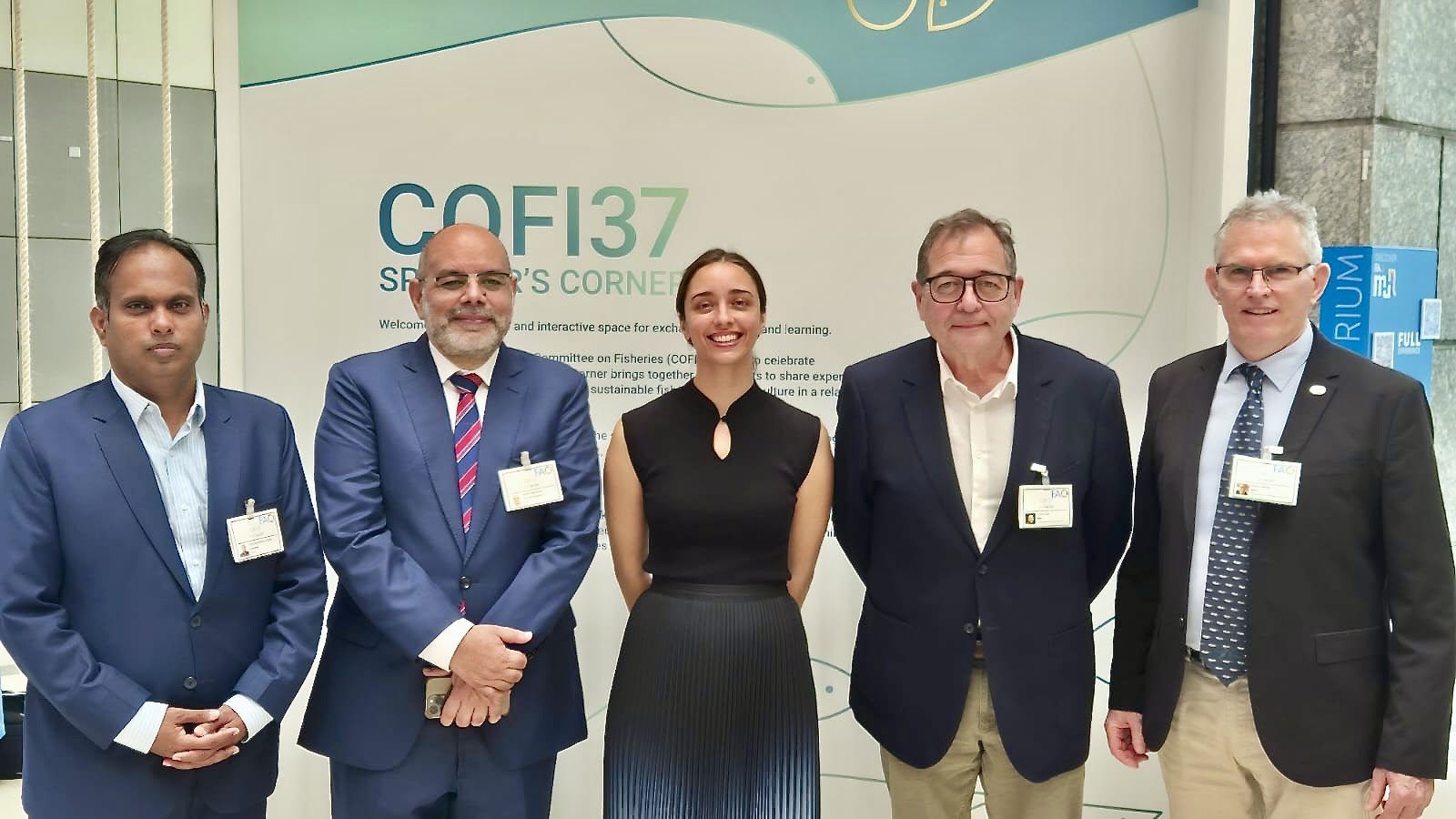
The Ministry of Maritime Affairs of Pakistan and IPNLF co-hosted a Speaker’s Corner session on this topic, looking to highlight solutions to make ecolabelling more accessible for small-scale fisheries. I provided an introductory framing before handing over to Gert le Roux from the Global Sustainable Seafood Initiative (GSSI), with Umar Zafar Sheikh from the Ministry providing a closing call to action.

Crucially, Gert highlighted that, when ensuring certification is accessible to small-scale fisheries, the underlying sustainability claim must remain equally robust while the ways of proving it can differ. This more flexible, context-sensitive approach needs clear rules for when different evidence or assessment approaches are acceptable and how their credibility is judged. Gert noted that this was where GSSI has an important role to play, not by prescribing a single certification model, but by setting the credibility guardrails within which flexibility can operate.
Clear direction from the Committee on Fisheries
Thanks in particular to efforts by Japan, COFI’s adopted report requests the FAO to continue advancing work to enhance market access for small-scale fisheries, including through complementary technical instruments to address the specific needs of small-scale fisheries. This provides the FAO with a clear mandate to proceed with a technical document providing guidance on how to adapt ecolabelling to small-scale fishery contexts.
Next steps towards more equitable market access
The FAO will be seeking budget resources to take the technical guide forward. We hope to see more detail on the process and timeline in the coming months.
The FAO will publish the full report ‘Analysis of ecolabelling certification schemes for small-scale fisheries and aquaculture’, which is likely to inform drafting of the technical guide itself.
IPNLF is grateful to the many States and organisations which have contributed to the significant progress achieved in raising the profile of this issue. We look forward to continued cooperative efforts to ensure equitable market access for small-scale fisheries.