
Indonesia’s pole‑and‑line tuna catch is on the order of tens of thousands of tonnes per year and is a vital way of life for many fishing communities. But there is scope for improvement if we’re to realise the potential of Indonesian pole-and-line fisheries.
“Compare a small-scale fishing vessel 150 years ago to one today and you will not see much innovation,” says Craig Turley, Fisheries Director at IPNLF. Globally, investment in vessel design, particularly in small-scale fisheries, lags behind other forms of transport, and in Turley’s view, part of the reason is structural. “Industrial fisheries are subsidised, and that discourages investment in the [small-scale] sector.”
The result is a fleet that has industrialised in scale without modernising in design. IPNLF’s own study into pole-and-line operations identified fuel consumption and the cost of live bait as two of the biggest drags on competitiveness for small-scale vessels.
“The first step was to identify what we could learn from vessels around the world,” Turley explains. “We looked at Maldivian boats, South African boats, Indonesian boats and Japanese boats. It was essential people looked at the different features of these boats and which features they wanted included in a new design. The second step was to ask: what does the best of the future look like for the Indonesian pole-and-line sector, and how do we get there?”
When participants were asked to choose between design references from South Africa, the Maldives and Japan, the majority gravitated towards Japanese-style vessels. Part of the appeal was familiarity: Japanese and Indonesian boats already share a similar bow design, a legacy of Japanese vessels introduced to Indonesia many years ago.
But the think tank wasn’t about importing a foreign design to the country. It was about finding the right design that worked within local constraints and conditions. Existing Indonesian pole-and-line boats are typically built from heavy wood, cost around $36,000 to build, and run on converted truck diesel engines, a low-investment approach that keeps boats affordable but does little to push efficiency. By contrast, larger vessels elsewhere in the fleet run three-to-four week trips and often return without a full load, burning significant fuel for a partial catch. The think tank’s ambition was a vessel that sat between these extremes, scalable up or down depending on the fishery.
Following the think tank, IPNLF commissioned a 3D model of a reference vessel to help visualise the design in detail. The resulting brief was for a vessel roughly 15 metres and 15 gross tonnes in size, accommodating a crew of seven. The rendered design is intended to capture the vessel’s key innovations, demonstrating how they could transform pole-and-line fishing.
From fish finders to live bait innovation, we share the most popular design features for the new vessel:
Fish finders
These are a decades-old technology, largely unadopted in the Indonesian small-scale fleet despite their low cost; commercial fish finders can retail for as little as $300. Fish finders use sound waves to reveal the seafloor profile and detect fish beneath the boat, at depths that can run into the thousands of metres depending on their sophistication.
An inverter-driven water sprayer system
Another key feature is how the water sprayers are powered. In the new design, they run from batteries via inverters, which convert direct current (DC) to alternating current (AC), so the pumps and other electronics can run on standard AC power. This means the electrics keep working on battery power even when the engine is off, and the batteries recharge once the engine is running again.
This lets the crew cut the engine while keeping the water pump, radar and safety equipment running, allowing the boat to fish silently at the grounds while also improving fuel efficiency. The spray itself is a long-standing feature of pole-and-line fishing worldwide, thought to disguise the vessel’s presence and mimic the commotion of surface-feeding tuna to attract fish.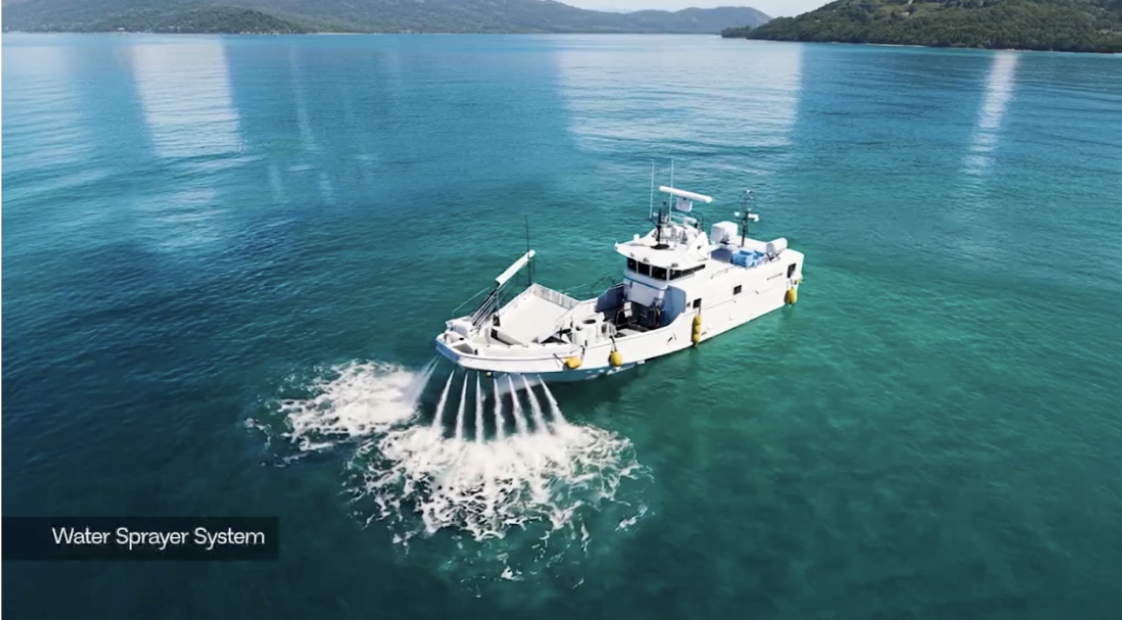
Personal and central live bait wells
Buying bait is a significant operating cost for pole-and-line vessels in Indonesia and can account to up to 40 percent of operating expenses during fishing trips.
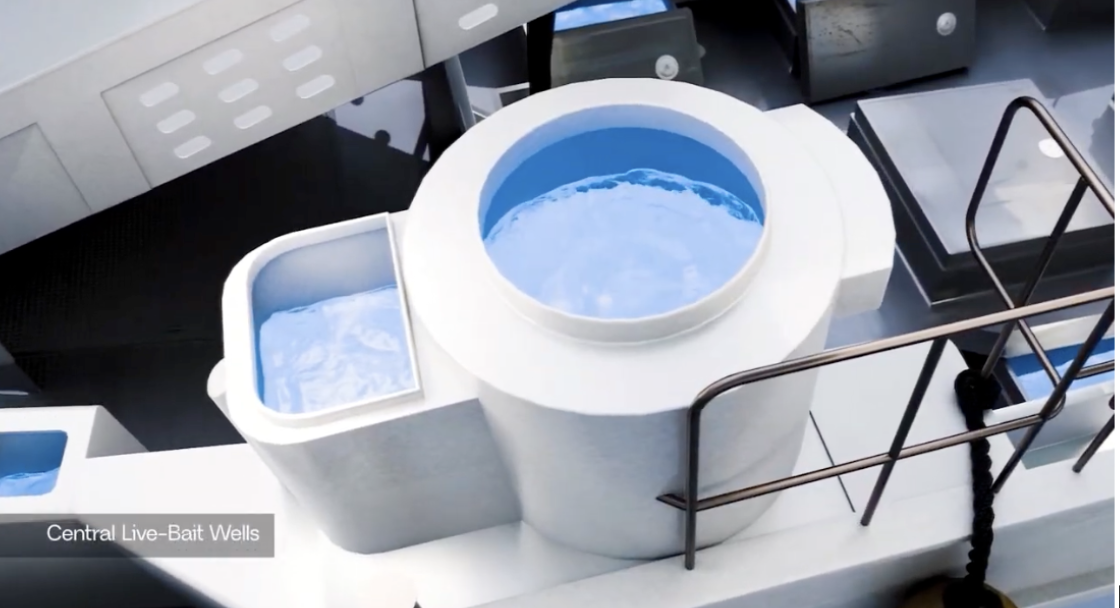
Currently, Indonesian live bait wells aren’t designed for proper water circulation, leading to high rates of bait mortality. The new design pairs a central below-deck bait system with individual, oxygenated wells for each fisher, reducing bait mortality and making it easier for fishers to use.
Improved fish handling system
The way a tuna fish is handled by the fisher within the first five minutes of it being caught makes or breaks the quality of the flesh and the price it will fetch at market. A sloped floor allows fish to fall by gravity into holds filled with slurry ice meaning they are iced almost immediately. This feature improves both fish quality and welfare.
Crew welfare improvements
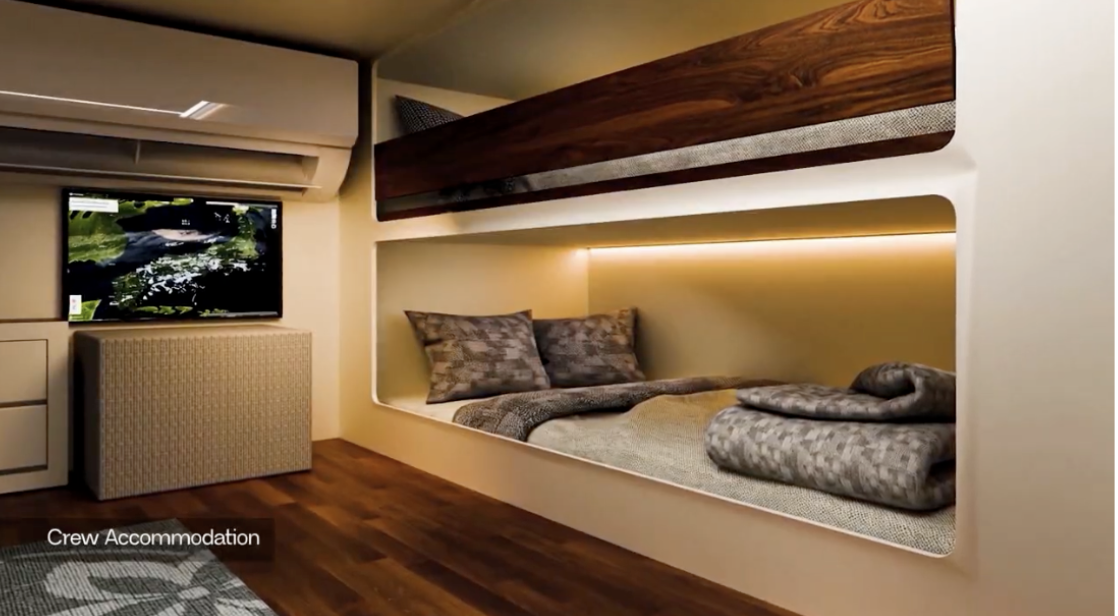
Good vessel design improves fisher welfare and safety. The new design also features enclosed galleys for shelter from rough seas and sun, and dedicated crew accommodation, reflecting the view that well-rested fishers are more efficient fishers.
A modernised wheelhouse
Bringing together fish finders, sonar, navigation, engine health monitoring and communications equipment in one space, alongside accommodation for a captain and second-in-command. This is a marked step up from the steering wheel and basic GPS most Indonesian pole-and-line boats currently rely on.
Technology and communication upgrades
Communication and safety are core to the vessel design and bolstered by a range of features and add-ons including radar, VHF radio and an Automatic Identification System (AIS). A chart plotter, GPS, AIS and radar would help with navigation and vessel detection, both during transit and in low-visibility conditions. Other safety features would include life rafts, an Emergency Position Indicating Radio Beacon (EPIRB), stocked medical supplies, and high-power LED floodlights around the mast and wheelhouse roof.
Lighter and more efficient vessels
One of the more contested questions was construction material. Wood has long been favoured in Indonesia because it can be repaired almost anywhere using local skills, an important consideration for a fleet with limited infrastructure. Fibreglass is significantly lighter and has the potential to be more fuel efficient. But it is also more expensive and has been harder to source local repair knowledge in remote areas historically, however, that is changing, making it a more viable choice for fleets.
This new design is an exciting step forward for the modernisation of Indonesia’s pole-and-line fleet. We see these innovations as vital to help keep the Indonesian pole-and-line sector resilient and cost competitive for decades to come. The next stage is the building of this new vessel design and capturing data on how this impacts efficiency.
Go here if you’re interested in hearing more about the future of pole-and-line vessel design.