
By Maskur Tamanyira
Maskur Tamanyira, IPNLF’s Fisheries Lead, shares an update from the field trials in Morotai.
Last month, IPNLF returned to Morotai in Eastern Indonesia to learn how a trial of solar-powered vessel trackers is impacting the small-scale fishers there. Local community leaders joined us, along with representatives from Yayasan Masyarakat dan Perikanan Indonesia (MDPI) to discuss early results directly with the people using the devices.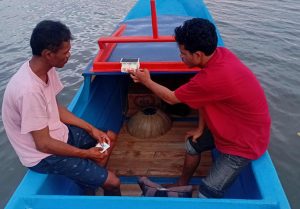
Since 2024, our team has been supporting trials of the ALON vessel-tracking devices to explore how emerging technologies can strengthen both safety at sea and traceability for low impact fisheries. During recent field visits, fishers described moments when the real-time tracking function helped locate colleagues in distress and offered families reassurances.
New technologies can support safer and more transparent fisheries
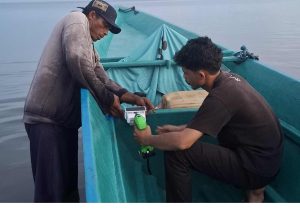
The solar-powered ALON device sends a location showing where and how long a vessel has been at sea. Fishers tap a card when a fish is caught, recording the time and position of each catch which improves supply-chain transparency. The device also features an SOS button that sends an immediate alert and the vessel’s last known location if a fisher encounters trouble.
 More transparency can offer better market access
Improved traceability is increasingly a prerequisite for accessing higher-value markets, securing fairer pricing, and demonstrating responsible fishing practices. Yet traditional traceability tools were developed for large industrial fleets, not for handline or pole-and-line vessels operating from remote coastal communities. They are often too costly, too power-hungry, or too complex for small-scale operators.
Meanwhile, small-scale fishers are facing rising pressures:
They are asked to meet the same transparency requirements as industrial fleets but with far fewer resources. Yet they also stand to gain the most from a fair, practical traceability system.
Morotai is a region rich in yellowfin tuna but exposed to external threats. Fishers work alone or in small crews, often with minimal safety equipment. Their fishing grounds intersect multiple management zones, and their ability to demonstrate responsible practices directly influences future opportunities.
 Traceability begins at sea
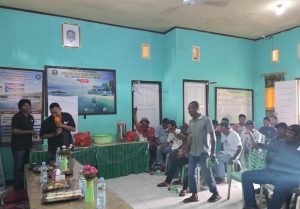
For the Morotai trial, fishers are the first data gatherers. The ALON device logs vessel activity and location, while regular SID (Sharing Information Data) meetings foster collaboration, transparency, and shared problem-solving. Together, these elements create a richer, more accurate picture of the fishery—mapping fishing grounds, identifying catch trends, improving safety zones, and even informing fuel-efficiency decisions. Currently, 91% of participating fishers say they want to continue using ALON, reflecting strong community appetite for tools that support both safety and sustainability.
A step toward scalable solutions
For IPNLF, Morotai is part of a broader effort to understand how innovation can meaningfully support small-scale fishers. The trial is offering valuable insights into what works, what doesn’t, and what still needs to be developed to achieve long-term, affordable, scalable solutions.
We will continue working closely with fishers, technology providers, government partners, and market partners to shape systems that strengthen livelihoods, improve safety, and build a more transparent and equitable tuna supply chain.
Interested in partnering with us on technology pilots with small-scale fisheries? Please contact us at info@ipnlf.org to find out more.