
By
A. Ismail Noval, Sustainable Fisheries Officer
I live in Ambon, and I have spent years working alongside the fishing communities of Maluku. These communities depend on the yellowfin tuna in nearby waters, a fishery that supports both local livelihoods and Indonesia’s position as one of the world’s major tuna producers.
They are also arguably at the frontline of climate change, as changing weather and currents impact the migratory paths of ocean life, often meaning fishers must travel further offshore to catch fish. This, in turn, can make fishing more dangerous.
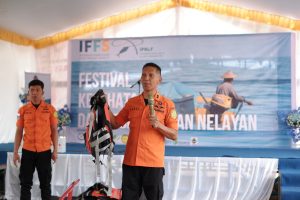 Earlier this year, IPNLF, with support from the International Fund for Fisher Safety (IFFS), ran the first health and safety at sea festival this village had ever seen. The goal was to engage fishing communities on health and safety in a novel way; and we were amazed by the response from the community, with some three hundred people joining the festival.
Parigi is a remote settlement, part of an archipelagic region where geography defines almost everything. Fishers here go out in small boats, often no bigger than a family car, travelling anywhere from ten to forty miles offshore using traditional handline methods. These are not industrial operations. They are families, working the water the way their parents and grandparents did.
Fewer than three in ten fishers globally have ever received any formal safety training. Reaching fishers can be challenging, as many are at sea during the day. It was key to get the community engaged on health and safety holistically.
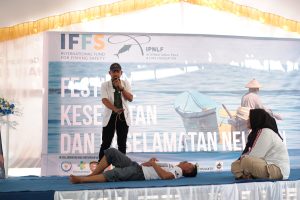 We designed the festival around free health checks, hands-on first aid training and practical fisher safety workshops, delivered with BASARNAS, Indonesia’s search and rescue, the local health office at Puskesmas Wahai, and government partners across Maluku.
Participants learned to recognise the signs of an emergency, how to respond, how to use the equipment that might one day save a life. One fisherman told me afterwards: “This is the first time something like this has happened for the fishers in Parigi. A festival like this is excellent and very beneficial because we get to know our health status and receive proper training.”
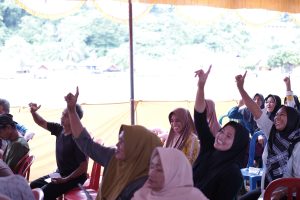 We made a deliberate choice to train the women of Parigi alongside the fishers, not as an afterthought but as a central part of the programme. Women play a vital role in the fishing industry and are often heavily involved in preparing and loading ice and provisions for trips, as well as processing and post-harvest work in many communities. They are also not bystanders to the risks their husbands face when at sea for long periods.
They are the ones left worrying when their husband doesn’t return until late. They are the ones managing the household, and often the finances, while their husband is out at sea.
As Ibu Lutna, who is married to one of the fishers, put it: “To be able to handle injuries myself, I feel very happy and relieved,” she told us. Another participant, Ramida Husin, also the wife of a fisher, said simply: “We gained valuable experience from it. Now we have something to hold onto so that if we encounter these situations in the future, we can provide help to those who need it.”
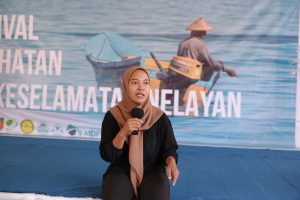 Working with fishers and their families is absolutely vital for us to succeed: a safety message delivered by an outsider can be ignored. A safety message delivered by a wife, at home, after she has been trained herself, can carry more weight.
This is also why I believe sustainability conversations in fisheries have to include the human dimension of this industry, the health, safety and economic security of fishers, is absolutely vital to the resilience of the whole sector.
What we built over those two days was not just an event. It was proof that this integrated approach, health, safety and community, delivered together, in partnership with the people who actually live the risk, can work in a remote Indonesian fishing village. I believe it can work in many more too.
The festival was organised by the International Pole & Line Foundation (IPNLF) and the International Fund for Fishing Safety (IFFS), in partnership with Dinas Kelautan dan Perikanan Provinsi Maluku, Dinas Perikanan Maluku Tengah, Puskesmas Wahai, BPJS Ketenagakerjaan, BASARNAS Ambon, Negeri Persiapan Administratif Parigi and PT. Aneka Sumber Tata Bahari.